Avian Influenza Viruses
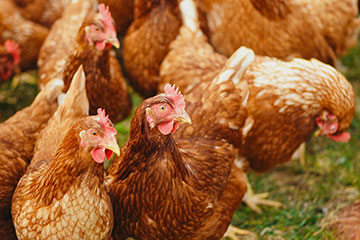
Influenza viruses that infect birds are called " avian influenza viruses." Only influenza A viruses infect birds. All known subtypes of influenza A virus can infect birds. However, there are substantial genetic differences between the subtypes that typically infect both people and birds. Within subtypes of avian influenza viruses there also are different strains (described in "Strains").
Avian influenza H5 and H7 viruses can be distinguished as "low pathogenic" and "high pathogenic" forms on the basis of genetic features of the virus and the severity of the illness they cause in poultry; influenza H9 virus has been identified only in a "low pathogenicity" form. Each of these three avian influenza viruses (H5, H7, and H9) can theoretically be partnered with any one of nine neuraminidase surface proteins; thus, there are potentially nine different forms of each subtype (e.g., H5N1, H5N2, H5N3,.H5N9).
Below is summary information about these three prominent subtypes of avian influenza virus:
Influenza A H5
- Potentially nine different subtypes
- Can be highly pathogenic or low pathogenic
- H5 infections have been documented among humans, sometimes causing severe illness and death
Influenza A H7
- Potentially nine different subtypes
- Can be highly pathogenic or low pathogenic
- H7 infection in humans is rare, but can occur among persons who have close contact with infected birds; symptoms may include conjunctivitis and/or upper respiratory symptoms
Influenza A H9
- Potentially nine different subtypes
- Documented only in low pathogenic form
- Three H9 infections in humans have been confirmed.
centers for Diseases Control and Prevention
http://www.cdc.gov/